Cost analysis
Paloma combines shipment records and invoices to explain which changes contributed to an increase in logistics costs.

AI for supply chain operations helps teams understand changing costs, follow deliveries and automate work across their records. Paloma is the operations management platform that connects those records in one warehouse you own and writes down your rules. We build tools on both, so procurement, logistics and operations can analyze costs and follow deliveries using the same definitions.
Book a call →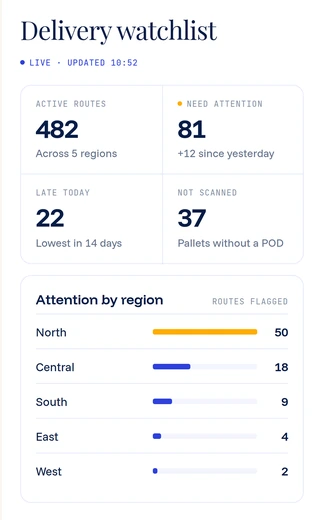




Paloma connects records and business definitions so procurement, logistics and operations can work from the same information.
The order may be in one system, the shipping cost in a spreadsheet and the reason for a delay in a message. We bring those sources into a data warehouse your company owns.
Your people explain how the records relate and what the measures mean. Once the system understands a cost definition, different teams can use it in their reports and investigations. This gives an answer a common basis that people can inspect and use when deciding what to do next.
Paloma combines shipment records and invoices to explain which changes contributed to an increase in logistics costs.
Teams use a delivery watchlist to follow routes and see which regions need attention as conditions change.
Paloma reads requests from email or spreadsheets and prepares ERP orders using the fields required by the system.
The delivery watchlist shows routes and live indicators, with the areas needing attention flagged by region.
Your team can use that view to follow deliveries and see where to investigate. It uses the same connected operational information that supports questions and reports. Our engineers establish the relevant records and business definitions with staff, so the dashboard reflects how the team understands its work.
“Between wasted logistics spend and time lost to reporting, we didn’t know how much money was walking out the door every month.”
A business rule explained by one team can become useful to other teams through Paloma.
For example, procurement can explain which charges belong in a cost measure. Logistics can then use that definition when investigating changes, and a recurring report can use it again.
Staff can add knowledge during daily work, with new assumptions presented for review. This reduces the need to explain the same business meaning for each new tool. Paloma’s team continues to investigate the operation and discuss improvements, while the company keeps the knowledge that makes those reports and tools useful.
AI can analyze connected records, identify changes and automate recurring work. Paloma applies it to cost investigations, delivery visibility, reports and order entry. We learn the business rules from your people so the tools use information in the way the operation requires.
Paloma connects ERP records with spreadsheets, documents, email and messages used in the operation. The relevant combination depends on the question or task. Our engineers work with your staff to understand where the information lives and how its definitions affect the result.
Staff explain their business terms and operating rules to Paloma. Those definitions become part of the shared company context used by reports and tools. A definition taught by procurement can therefore support a logistics investigation, with the system asking staff to review new assumptions.
Yes. Paloma can examine shipment records and carrier invoices, apply your cost definition and show the calculation behind an increase. The team can inspect the evidence and turn the analysis into a recurring report to follow changes in later periods.
Paloma works with your team to understand the operation and rank gaps by their potential value. We discuss what to build with the people who know the work. The result may be an analysis, alert, agent or internal tool, depending on what the problem requires.
Paloma builds alongside your existing systems. During the pilot, we use read-only access and produce reports or exports for your staff to check.
Your team continues its usual work while we prepare the tool. They validate the output before adopting it, and actions that change records require their approval.
We sign an NDA and document access permissions before accessing your data. Your IT team reviews the access framework, and the pilot uses read-only access.
Paloma runs on dedicated infrastructure with encryption in transit and at rest. Model providers operate under zero-retention enterprise agreements that prevent them from retaining your data or using it for training.
Paloma delivers working tools within weeks. The schedule for your work depends on the sources we need to connect and the process your staff need to validate.
Speedrun is a separate one-week programme. It combines AI training, a review of the operation, an adoption roadmap and a first working tool.
Onboarding once, then a monthly subscription that grows with the work Paloma takes on. You pay for the responsibility taken on as the system keeps running and we keep improving it with you. The Speedrun week is one fixed price. Numbers on the call.
You can book a call while you are still deciding where AI could help. No technical brief or selected task is required.
The call is free and takes 30 minutes. We listen to how your operation works, discuss your questions and consider whether Paloma fits the help you need.
A logistics cost increase no one can explain, or teams counting the same cost differently. Start with a free, 30 minute call about where the questions begin.
Book a call →