Connected information
Company records and staff knowledge give reports and tools a shared view of how the operation works.

Paloma is the operations management platform that unifies your company's data, knowledge and processes. We connect your ERP, spreadsheets, email and group chats in one warehouse you own. We write down your team's rules and build tools around how you work. The ERP stays and gets connected, giving your people one system for the work around it.
Book a call →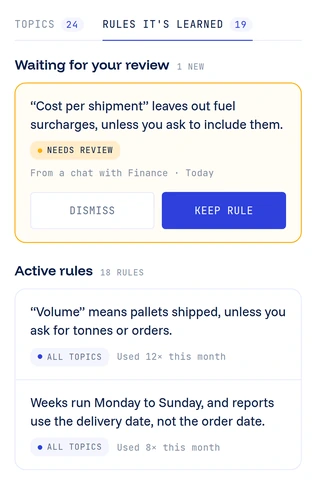




Paloma connects the information spread across your systems and teaches the software how your operation uses it. The connected records and business definitions give its tools a common basis for work.
Your ERP may hold the order while a spreadsheet holds shipping costs and a WhatsApp message explains a delay. Our engineers bring the relevant information into a data warehouse your company owns. Staff explain the terms and exceptions needed to interpret it.
Reports, dashboards and agents can then use the same context. The connections support both understanding the operation and performing approved tasks across systems.
Company records and staff knowledge give reports and tools a shared view of how the operation works.
Ask a question about the business and examine the sources and calculations used to answer it.
Agents perform approved work, such as moving an order from an incoming email into the ERP.
Staff can review new assumptions and teach Paloma the definitions their teams use. The rules screen shows what the system has learned and what still needs review.
A definition of volume or a reporting-week boundary can then serve other reports and tools. This lets teams use shared operating knowledge as they work with information from different systems.
“Between wasted logistics spend and time lost to reporting, we didn’t know how much money was walking out the door every month.”
The first workflow connects the data and writes down your team's rules. Each next workflow starts from what the system already knows, so we can build on that knowledge as we improve the operation with you.
We examine patterns, bring recommendations and discuss which changes deserve attention next. A recurring question can become a scheduled report. A repeated task can become an agent, with your approval for the actions it performs.
Your people also keep teaching the system how the operation works. New definitions and knowledge become available to later builds, so the common foundation grows with the work your team asks it to support.
It contains connected company data, operating definitions and software that uses them to answer questions or perform work. Paloma’s engineers create the connections and learn the rules with your staff. Reports, dashboards, agents and internal tools then share that business context as they support different jobs.
Yes. Paloma builds on your current systems and connects the relevant information around them. Your staff continue their usual work while we prepare the tool in parallel. We start with read-only access, and the team validates the new outputs before adopting the software.
Paloma connects relevant spreadsheets, documents and messages alongside ERP records. Your staff explain what the information means, including operating definitions and exceptions. A logistics analysis can then use both shipment records and costs held elsewhere, with the sources and calculation visible for staff to inspect.
Yes. Paloma can perform approved tasks across systems, such as creating ERP orders from requests sent by email or spreadsheet. It runs autonomously where you approve that action and waits for approval elsewhere. During the pilot, outputs remain read-only reports or exports for staff to check.
Your company owns the data warehouse Paloma builds. We bring the relevant records together there and use them to support reports, dashboards and tools. Your staff also help define the business terms, giving later work access to both the connected information and the knowledge needed to interpret it.
Staff can add the terms, rules and definitions they use during their work. Paloma asks them to review new assumptions before accepting them. The resulting knowledge stays available to the company, so another team can use a definition in its own report or tool.
Paloma continues to examine operating problems and discuss improvements with your team through regular reviews. We bring findings and recommendations, then build the agreed changes. Training helps staff recognize other applications and contribute ideas, so the work can develop as their needs and knowledge grow.
We sign an NDA and document access permissions before accessing data. Your IT team reviews the access framework, and the pilot is read-only. Paloma uses dedicated infrastructure and encryption in transit and at rest. Zero-retention enterprise agreements prevent model providers from storing your data or using it to train models.
Paloma delivers working tools within weeks. We discuss the particular work and its timing once we understand the process and information it needs. Speedrun has a separate one-week schedule covering AI training, an adoption plan and a first live solution; we can discuss which engagement fits.
Onboarding once, then a monthly subscription that grows with the work Paloma takes on. You pay for the responsibility taken on as the system keeps running and we keep improving it with you. The Speedrun week is one fixed price. Numbers on the call.
The order is in the ERP, its shipping cost in a spreadsheet and the delay explained in a chat. Start there in a free, 30 minute call.
Book a call →