The operating problem
We listen to how your team works and where delays, manual effort or unanswered questions cause difficulty.

Start with a free, 30 minute call about where the manual work lives, even if you can't put the problem into words yet. Paloma is the operations management platform built with your team. We scope a known workflow so you see it on your data before committing, or the Speedrun week ranks the problems and builds the first one.
Book a call →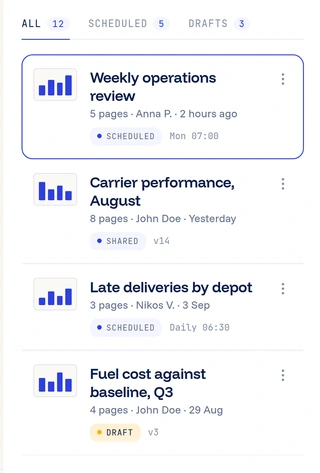




You tell us where the manual work lives, and we tell you where to start. We can scope a workflow you know and show it on your data before you commit, or use the Speedrun week to rank the problems and build the first one.
We listen to how your team operates and discuss where data, software or AI could help. A question about slow reporting might lead to a discussion about where the figures come from and who checks them.
We tell you whether to start by scoping a known workflow or with the Speedrun week, or that you shouldn't yet. If it is too early, we explain what to address first.
We listen to how your team works and where delays, manual effort or unanswered questions cause difficulty.
We discuss how connected data, reports, agents or internal tools could help with the work you describe.
We discuss scoping a known workflow or taking the Speedrun week, and tell you if you shouldn't start yet.
A recurring report is one possible result of the work we can discuss.
Paloma’s reports screen brings scheduled, shared and draft reports together. A morning report can reach staff in WhatsApp before their shift, using the operation’s data. During the conversation, we can discuss whether reporting or another application would be useful for your team.
“Between wasted logistics spend and time lost to reporting, we didn’t know how much money was walking out the door every month.”
Speedrun gives your team a week to learn about AI, map the operation and put a first solution into use. It is a separate engagement that you can consider after the diagnostic conversation.
The week starts with AI fundamentals and a review of how the operation works. We then create an adoption plan and build its first item. By Friday, your team has a live solution, a roadmap and a better understanding of the technology.
That experience helps staff judge further opportunities. They can relate what AI can do to the orders, schedules and reports they handle every day.
Yes. The diagnostic call is free and takes 30 minutes. You tell us where the manual work lives, and we discuss where to start: scoping a known workflow or using the Speedrun week to rank the problems and build the first one.
No. You can book while you are still trying to describe the problem. We can discuss how the work happens and where you would like help. You do not need to choose an automation task, prepare a technical specification or decide on software before speaking with us.
You get our view on where to start: a workflow we can scope and show on your data before you commit, or the Speedrun week to rank the problems and build the first one. If you shouldn't start yet, we explain what to address first.
The call helps you decide whether to proceed; Speedrun is the week of training, planning and building. During that week, we teach AI fundamentals, map the operation, create an adoption plan and build its first item. The call itself does not include that implementation work.
We build alongside your current systems while staff continue their usual work. The pilot uses read-only access and produces reports or exports. Your team checks those outputs before adopting the tool. That gives the people who understand the job a way to validate the result before it changes daily work.
Staff can add the terms, rules and definitions they use during their work. Paloma asks them to review new assumptions before accepting them. The resulting knowledge stays available to the company, so another team can use a definition in its own report or tool.
Paloma continues to examine operating problems and discuss improvements with your team through regular reviews. We bring findings and recommendations, then build the agreed changes. Training helps staff recognize other applications and contribute ideas, so the work can develop as their needs and knowledge grow.
We sign an NDA and document access permissions before accessing data. Your IT team reviews the access framework, and the pilot is read-only. Paloma uses dedicated infrastructure and encryption in transit and at rest. Zero-retention enterprise agreements prevent model providers from storing your data or using it to train models.
The conversation is for people running manufacturing and supply chain operations who want to understand where Paloma could help. You might have a recurring manual task, an unanswered performance question or a broader concern about how the team works. We can discuss those situations before choosing an application.
Onboarding once, then a monthly subscription that grows with the work Paloma takes on. You pay for the responsibility taken on as the system keeps running and we keep improving it with you. The Speedrun week is one fixed price. Numbers on the call.
Reporting feels slow, or the problem is still hard to put into words. Either is a fine place to start a free, 30 minute call.
Book a call →